An all-in-one package of Data structures and algorithms for navigating them
Developer's Note: Now I know that this project isn't a super exciting web app or game that can be interacted with, but as a programmer who is focused on backend development I thought that I would take some time to really learn and understand some of the most commonly used data structures and their respective navigation algorithms. All Data structures are built using template types so that they can be used with any data type or even custom types.
(To ensure that custom types work, it is reccommended that the comparison and ostream operators are overloaded)
The structures present include the following:
Dynamic Array
Linked List
Doubly-Linked-List
Skip List
Stack (list and array based)
Queue (list and array based)
Deque (list and array based)
Hash Table (all collision methods: linear probing, quadratic probing, double hashing)
Binary Tree
AVL Tree
Splay Tree
Red-Back Tree
Min Heap
Max Heap
Graphs (depth-first search, breadth first search, A*, Djikstra's)
A dynamic array is an array that will vary its size as elements are inserted and removed. By doubling the size of the array any time that too many elements are inserted, the dynamic array is able to run with an average time complexity of O(1). If the array did not double in size and instead simply grew 1 additional spot for each entry, the time complexity would be O(n) since every exisiting element would need to be copied every single time a new element was inserted.
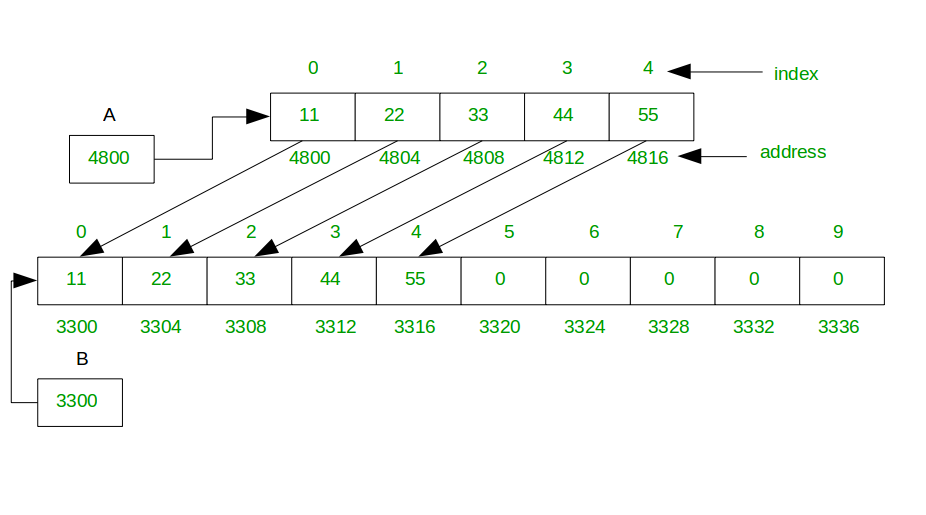
Insert (void insert(T element)) - inserts an element at the end of the Dynamic Array. Resizes the array if the element would overflow the array
Remove (void remove(int position)) - removes an element at a given position. Resizes the array if the number of elements decreases to 1/2 the size allocated
Find (int find(T element)) - Finds the first instance of a given element. Returns the index of the first instance (requires data type T to have an overloaded == operator)
Findall (DynamicArray<int> findall(T element)) - Finds all instances of a given element. Returns a Dynamic Array of the indices where the element is located (requires data type T to have an overloaded == operator)
Sort (void sort()) - Uses Mergesort to sort the elements in the list from smallest to largest in O(nlogn) time (requires data type T to have overloaded comaprison operators)
Access (via overloaded [] operator) - returns the value at a given position
Print (via overloaded << operator) - prints all of the elements of the array in the format "{a, b, c}" (requires data type T to have an overloaded << operator)
Copy (via overloaded = operator) - creates a deep copy of a Dynamic Array
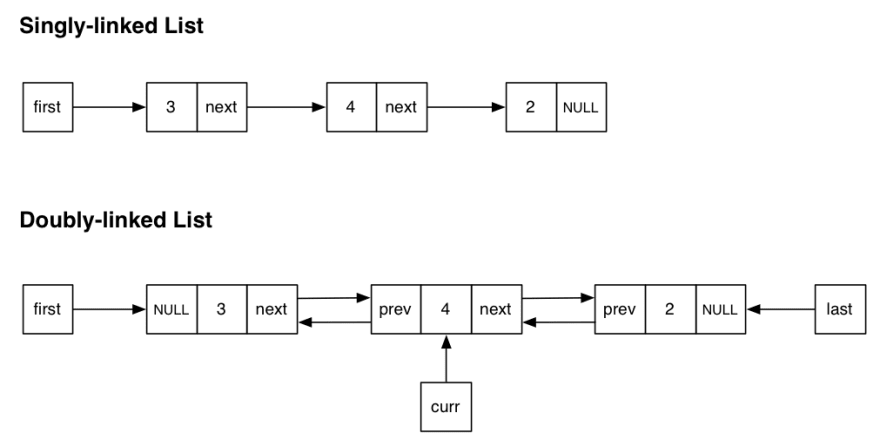
A Linked List is a chain of nodes that each point to the next node in the list. By doing so, linked lists are capable of growing and shrinking in space to allow for dynamic storage, contrary to basic arrays. Despite this improvement, Nodes in a linked list do not know in which position they lie, so in order to traverse the list, a program must begin at the head of the list and work its way to the tail. Despite this drawback, linked lists are still very useful especially for implementing stacks and queues, 2 other data structures. There are two main types of linked lists: singly-linked and doubly-linked. The difference between the two is as follows: The nodes in a singly linked list only point to the next node in the list, and the list only has 1 point of reference for access, the head. On the other hand, the nodes in a doubly linked list point to the next and previous nodes in the list, and the list itself has two reference points for accessing, the head and the tail.
Insert:
Insert Front
Insert Back
Insert At
Remove
Remove Front
Remove Back
Remove At
Swap
Find
Sort
Access
Copy