new

Get trending papers in your email inbox!

Subscribe

Trending Papers

byAK and the research community

Trending Papers

AutoDev: Automated AI-Driven Development

AutoDev is an AI-driven software development framework that automates complex engineering tasks within a secure Docker environment, achieving high performance in code and test generation.

  • 5 authors
· Mar 13, 2024
Submitted by
evanking

Flavors of Moonshine: Tiny Specialized ASR Models for Edge Devices

Monolingual ASR models trained on a balanced mix of high-quality, pseudo-labeled, and synthetic data outperform multilingual models for small model sizes, achieving superior error rates and enabling on-device ASR for underrepresented languages.

  • 5 authors
· Sep 2, 2025

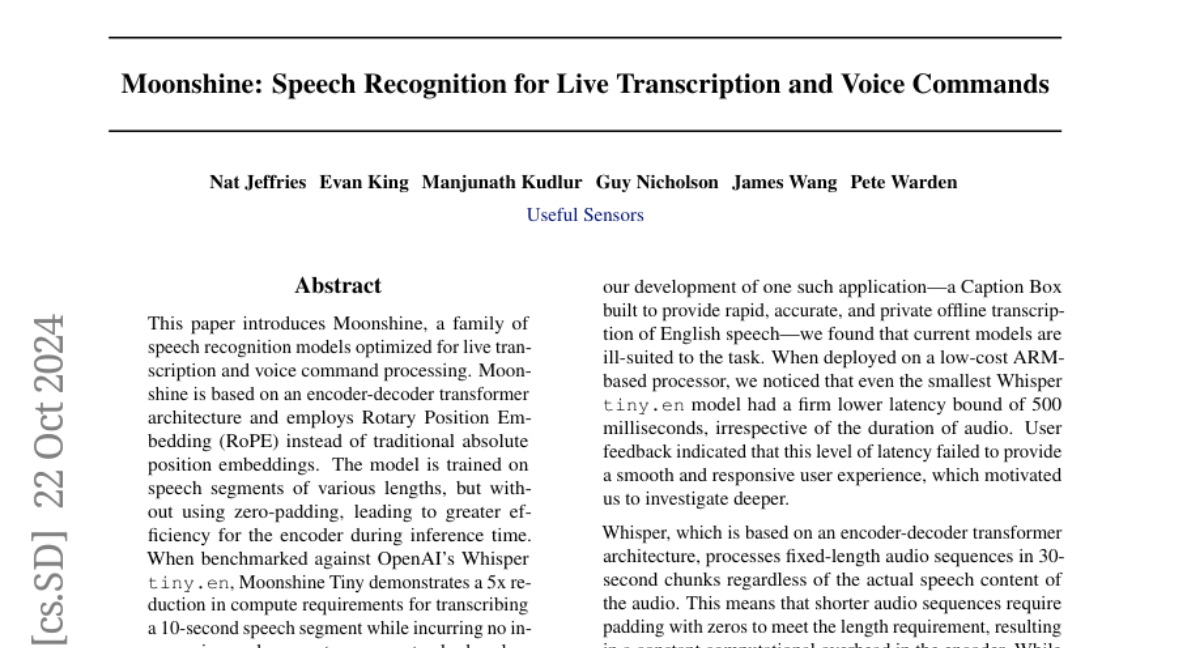
Moonshine: Speech Recognition for Live Transcription and Voice Commands

Moonshine, an encoder-decoder transformer architecture for speech recognition, uses Rotary Position Embedding, reducing compute requirements without decreasing accuracy.

  • 6 authors
· Oct 21, 2024
Submitted by
parachas

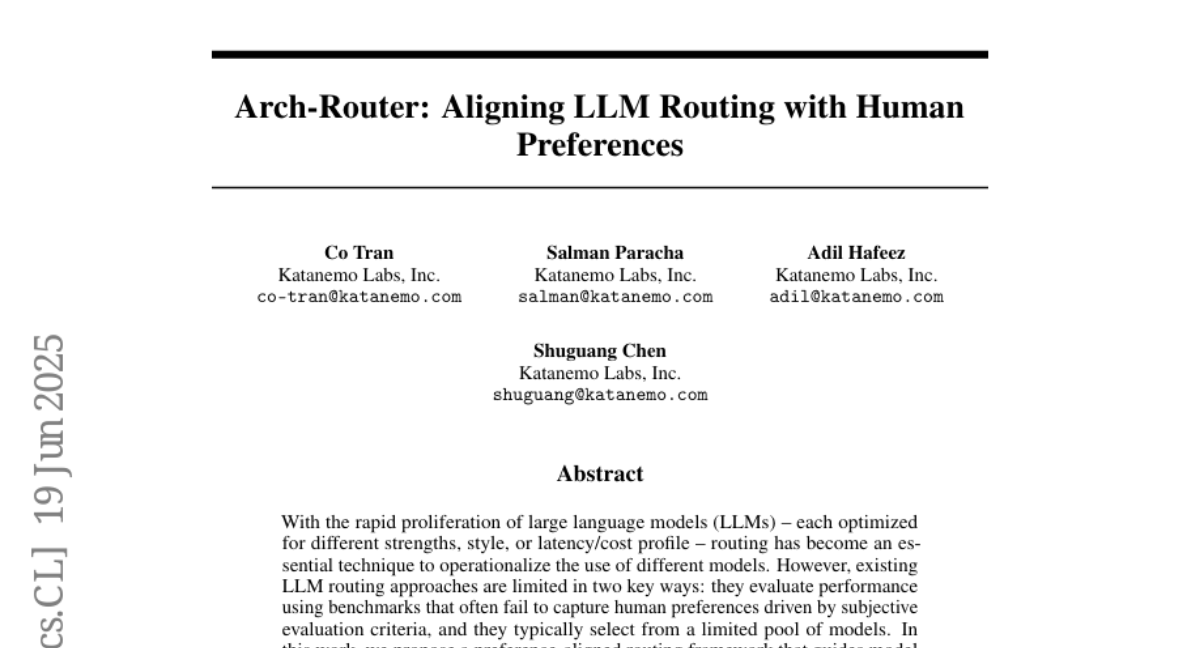
Arch-Router: Aligning LLM Routing with Human Preferences

A preference-aligned routing framework using a compact 1.5B model effectively matches queries to user-defined domains and action types, outperforming proprietary models in subjective evaluation criteria.

  • 4 authors

· Jun 19, 2025

A decoder-only foundation model for time-series forecasting

A large language model adapted for time-series forecasting achieves near-optimal zero-shot performance on diverse datasets across different time scales and granularities.

  • 4 authors
· Oct 14, 2023
Submitted by
taesiri

PersonaLive! Expressive Portrait Image Animation for Live Streaming

PersonaLive is a diffusion-based portrait animation framework that improves real-time performance through hybrid implicit signals, appearance distillation, and autoregressive streaming generation.

TradingAgents: Multi-Agents LLM Financial Trading Framework

A multi-agent framework using large language models for stock trading simulates real-world trading firms, improving performance metrics like cumulative returns and Sharpe ratio.

  • 4 authors
· Dec 28, 2024
Submitted by
andito

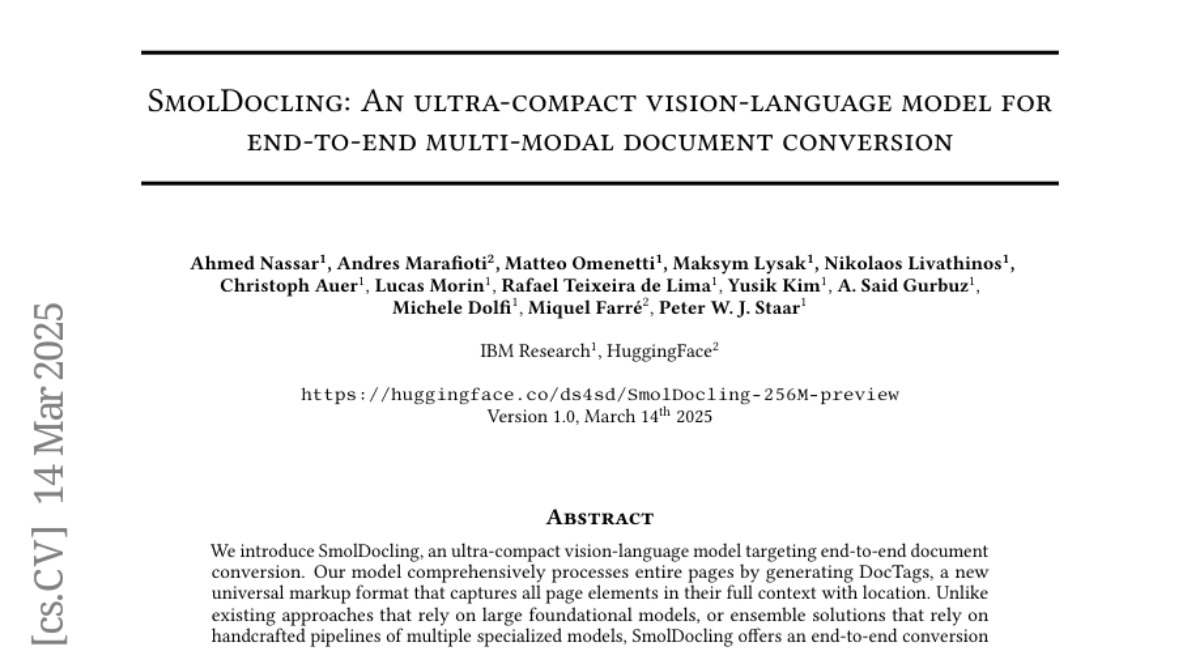
SmolDocling: An ultra-compact vision-language model for end-to-end multi-modal document conversion

SmolDocling is a compact vision-language model that performs end-to-end document conversion with robust performance across various document types using 256M parameters and a new markup format.

ibm-granite IBM Granite · Mar 14, 2025
Submitted by
akhaliq

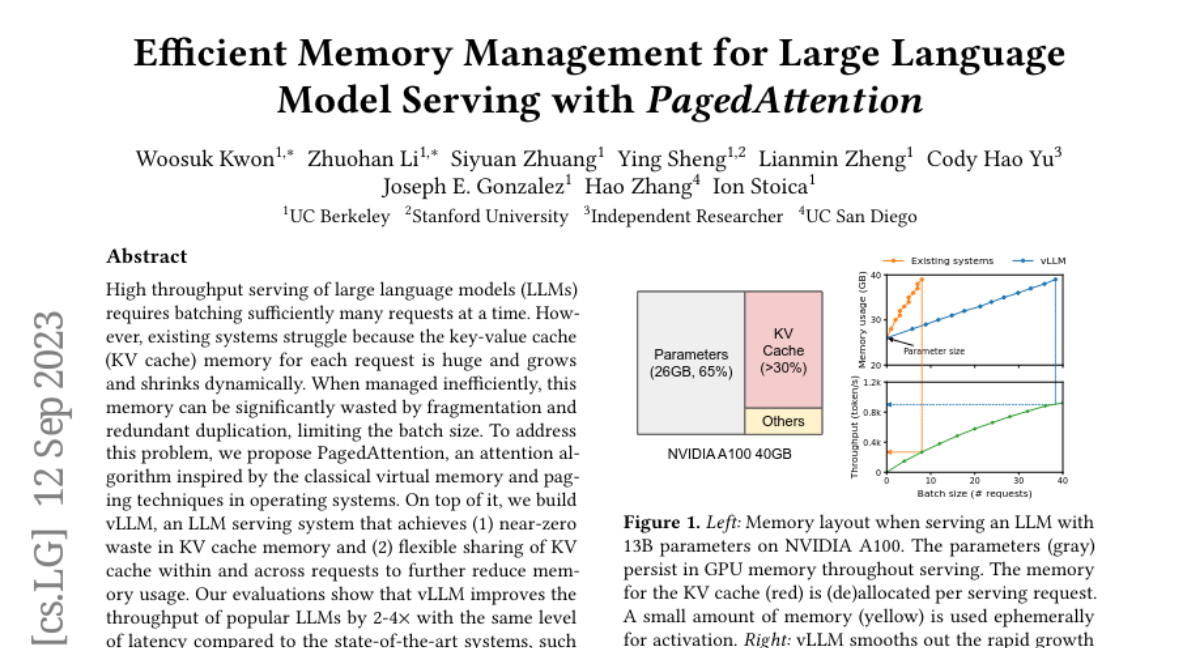
Efficient Memory Management for Large Language Model Serving with PagedAttention

PagedAttention algorithm and vLLM system enhance the throughput of large language models by efficiently managing memory and reducing waste in the key-value cache.

  • 9 authors
· Sep 12, 2023
Submitted by
taesiri

Qwen3-TTS Technical Report

The Qwen3-TTS series presents advanced multilingual text-to-speech models with voice cloning and controllable speech generation capabilities, utilizing dual-track LM architecture and specialized speech tokenizers for efficient streaming synthesis.

Qwen Qwen · Jan 22, 2026
Submitted by
akhaliq

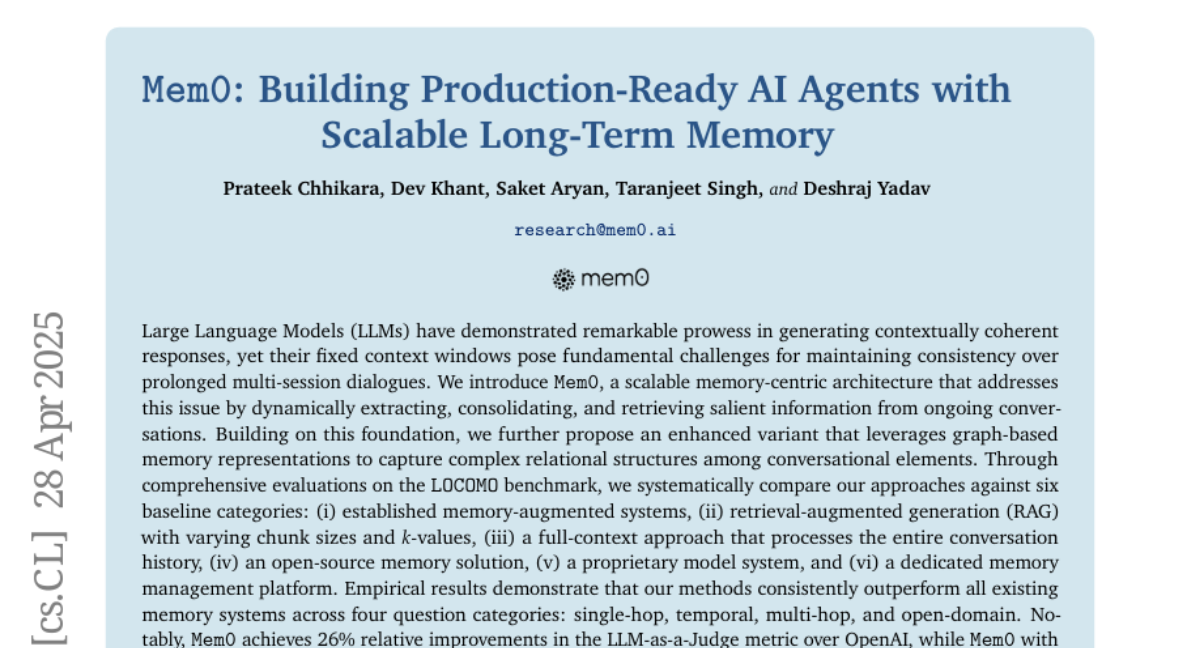
Mem0: Building Production-Ready AI Agents with Scalable Long-Term Memory

Mem0, a memory-centric architecture with graph-based memory, enhances long-term conversational coherence in LLMs by efficiently extracting, consolidating, and retrieving information, outperforming existing memory systems in terms of accuracy and computational efficiency.

  • 5 authors
· Apr 28, 2025
Submitted by
taesiri

PaperBanana: Automating Academic Illustration for AI Scientists

_paperbanana is an agentic framework that automates the creation of publication-ready academic illustrations using advanced vision-language models and image generation techniques.

google Google · Jan 30, 2026
Submitted by
taesiri

MinerU2.5: A Decoupled Vision-Language Model for Efficient High-Resolution Document Parsing

MinerU2.5, a 1.2B-parameter document parsing vision-language model, achieves state-of-the-art recognition accuracy with computational efficiency through a coarse-to-fine parsing strategy.

  • 61 authors
· Sep 26, 2025
Submitted by
hao-li

Agent READMEs: An Empirical Study of Context Files for Agentic Coding

Agentic coding tools receive goals written in natural language as input, break them down into specific tasks, and write or execute the actual code with minimal human intervention. Central to this process are agent context files ("READMEs for agents") that provide persistent, project-level instructions. In this paper, we conduct the first large-scale empirical study of 2,303 agent context files from 1,925 repositories to characterize their structure, maintenance, and content. We find that these files are not static documentation but complex, difficult-to-read artifacts that evolve like configuration code, maintained through frequent, small additions. Our content analysis of 16 instruction types shows that developers prioritize functional context, such as build and run commands (62.3%), implementation details (69.9%), and architecture (67.7%). We also identify a significant gap: non-functional requirements like security (14.5%) and performance (14.5%) are rarely specified. These findings indicate that while developers use context files to make agents functional, they provide few guardrails to ensure that agent-written code is secure or performant, highlighting the need for improved tooling and practices.

  • 11 authors
· Nov 17, 2025
Submitted by
taesiri

Solaris: Building a Multiplayer Video World Model in Minecraft

Solaris is a multiplayer video world model that simulates consistent multi-view observations through a novel data collection system and staged training approach.

  • 9 authors
· Feb 25, 2026
Submitted by
XuGuo699

DreamID-Omni: Unified Framework for Controllable Human-Centric Audio-Video Generation

DreamID-Omni is a unified framework for controllable human-centric audio-video generation that uses a symmetric conditional diffusion transformer with dual-level disentanglement and multi-task progressive training to achieve state-of-the-art performance.

ByteDance ByteDance · Feb 12, 2026
Submitted by
taesiri

PaddleOCR-VL: Boosting Multilingual Document Parsing via a 0.9B Ultra-Compact Vision-Language Model

PaddleOCR-VL, a vision-language model combining NaViT-style dynamic resolution and ERNIE, achieves state-of-the-art performance in document parsing and element recognition with high efficiency.

PaddlePaddle PaddlePaddle · Oct 16, 2025
Submitted by
tylerlum

SimToolReal: An Object-Centric Policy for Zero-Shot Dexterous Tool Manipulation

SimToolReal enables generalizable robot manipulation of diverse tools through procedural simulation and universal reinforcement learning policies without task-specific training.

StanfordUniversity Stanford University · Feb 18, 2026

OmniFlatten: An End-to-end GPT Model for Seamless Voice Conversation

A novel GPT-based model, OmniFlatten, enables real-time natural full-duplex spoken dialogue through a multi-stage post-training technique that integrates speech and text without altering the original model's architecture.

  • 9 authors
· Oct 23, 2024
Submitted by
taesiri

GLM-5: from Vibe Coding to Agentic Engineering

GLM-5 advances foundation models with DSA for cost reduction, asynchronous reinforcement learning for improved alignment, and enhanced coding capabilities for real-world software engineering.

  • 186 authors
· Feb 17, 2026

LightRAG: Simple and Fast Retrieval-Augmented Generation

LightRAG improves Retrieval-Augmented Generation by integrating graph structures for enhanced contextual awareness and efficient information retrieval, achieving better accuracy and response times.

  • 5 authors
· Oct 8, 2024
Submitted by
chenwang

tttLRM: Test-Time Training for Long Context and Autoregressive 3D Reconstruction

A novel 3D reconstruction model called tttLRM uses a Test-Time Training layer to enable efficient, scalable autoregressive reconstruction with linear complexity, achieving better results than existing methods.

  • 9 authors
· Feb 23, 2026
Submitted by
stzhao

PyVision-RL: Forging Open Agentic Vision Models via RL

PyVision-RL framework addresses interaction collapse in multimodal models through enhanced reinforcement learning techniques and efficient video processing strategies.

  • 7 authors
· Feb 24, 2026
Submitted by
ahmedheakl

Mobile-O: Unified Multimodal Understanding and Generation on Mobile Device

A compact vision-language-diffusion model called Mobile-O enables efficient unified multimodal understanding and generation on mobile devices through specialized architecture design and optimized training methodology.

Submitted by
akhaliq

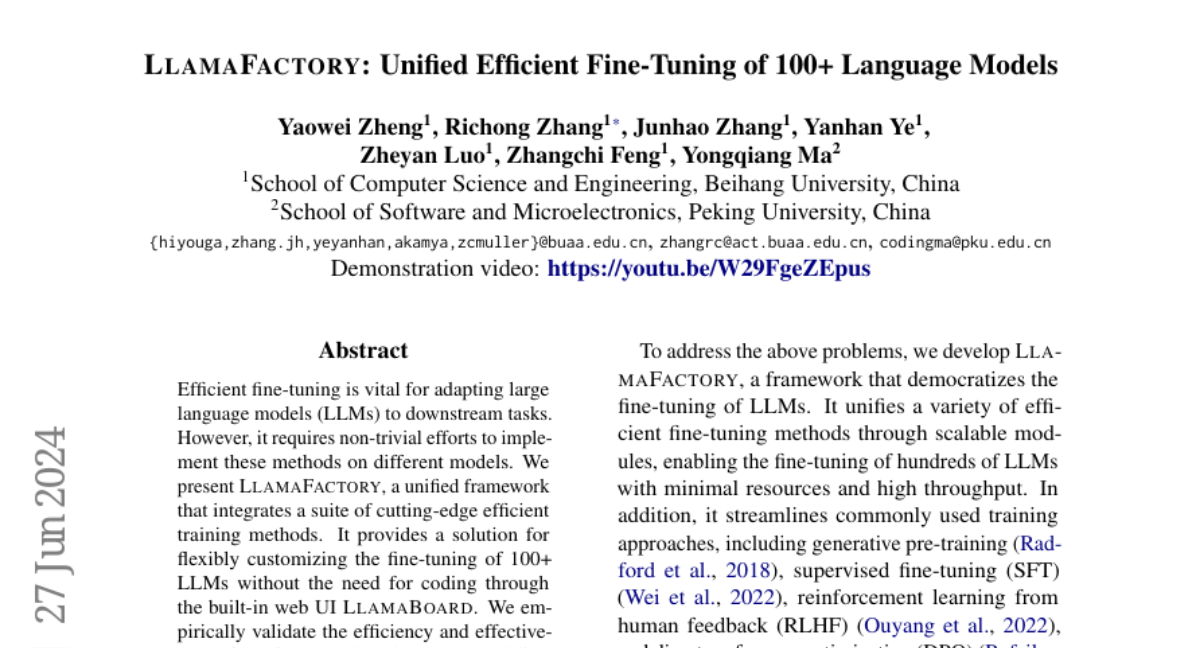
LlamaFactory: Unified Efficient Fine-Tuning of 100+ Language Models

LlamaFactory is a unified framework enabling efficient fine-tuning of large language models across various tasks using a web-based user interface.

  • 5 authors
· Mar 20, 2024
Submitted by
akhaliq

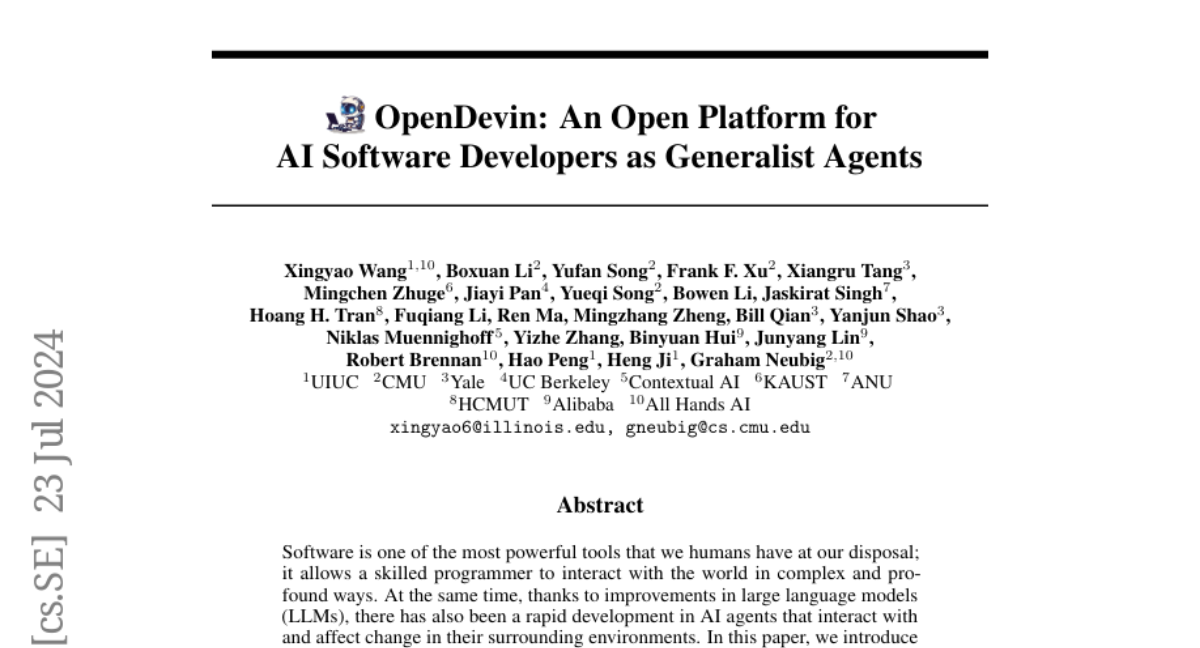
OpenDevin: An Open Platform for AI Software Developers as Generalist Agents

OpenDevin is a platform for developing AI agents that interact with the world by writing code, using command lines, and browsing the web, with support for multiple agents and evaluation benchmarks.

  • 24 authors
· Jul 23, 2024
Submitted by
UglyToilet

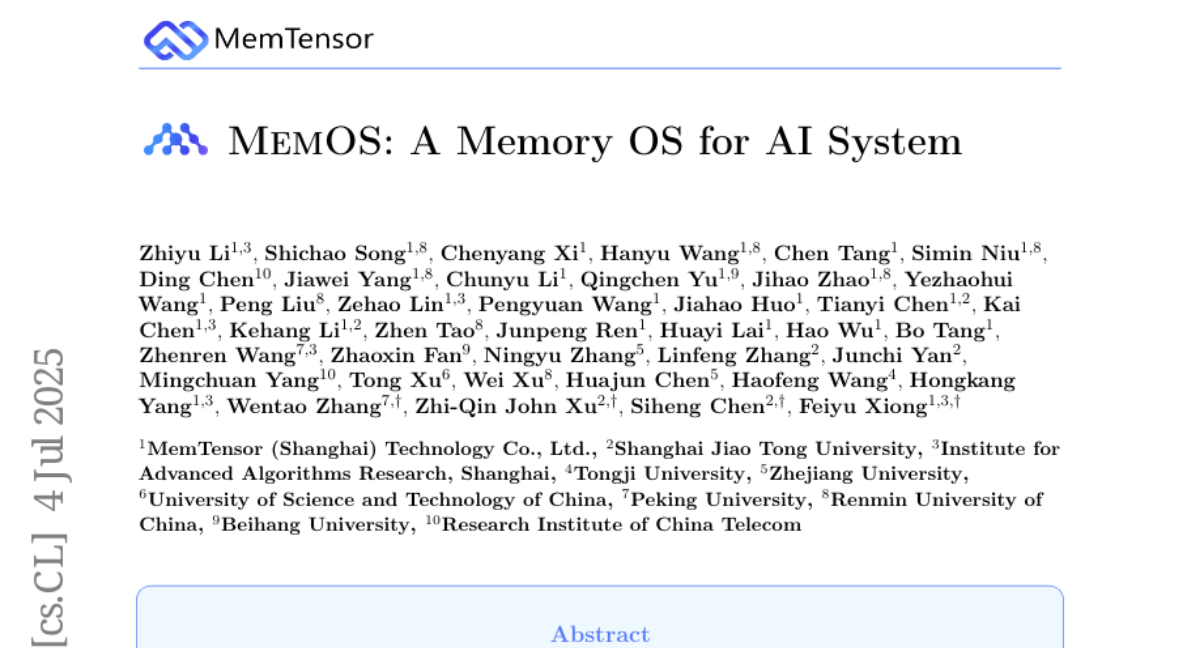
MemOS: A Memory OS for AI System

MemOS, a memory operating system for Large Language Models, addresses memory management challenges by unifying plaintext, activation-based, and parameter-level memories, enabling efficient storage, retrieval, and continual learning.

  • 39 authors
· Jul 4, 2025

Self-Supervised Prompt Optimization

A self-supervised framework optimizes prompts for both closed and open-ended tasks by evaluating LLM outputs without external references, reducing costs and required data.

  • 9 authors
· Feb 7, 2025
Submitted by
kpzhang996

LongCLI-Bench: A Preliminary Benchmark and Study for Long-horizon Agentic Programming in Command-Line Interfaces

LongCLI-Bench evaluates AI agents' ability to complete complex, multi-step programming tasks through command-line interfaces with detailed failure analysis and human-agent collaboration insights.

  • 19 authors

· Feb 15, 2026
Submitted by
Rbin

RAG-Anything: All-in-One RAG Framework

RAG-Anything is a unified framework that enhances multimodal knowledge retrieval by integrating cross-modal relationships and semantic matching, outperforming existing methods on complex benchmarks.

Submitted by
taesiri

BitDance: Scaling Autoregressive Generative Models with Binary Tokens

BitDance is a scalable autoregressive image generator that uses binary visual tokens and diffusion-based methods to achieve efficient high-resolution image generation with improved speed and performance.

ByteDance ByteDance · Feb 15, 2026

Kronos: A Foundation Model for the Language of Financial Markets

Kronos, a specialized pre-training framework for financial K-line data, outperforms existing models in forecasting and synthetic data generation through a unique tokenizer and autoregressive pre-training on a large dataset.

  • 7 authors
· Aug 2, 2025

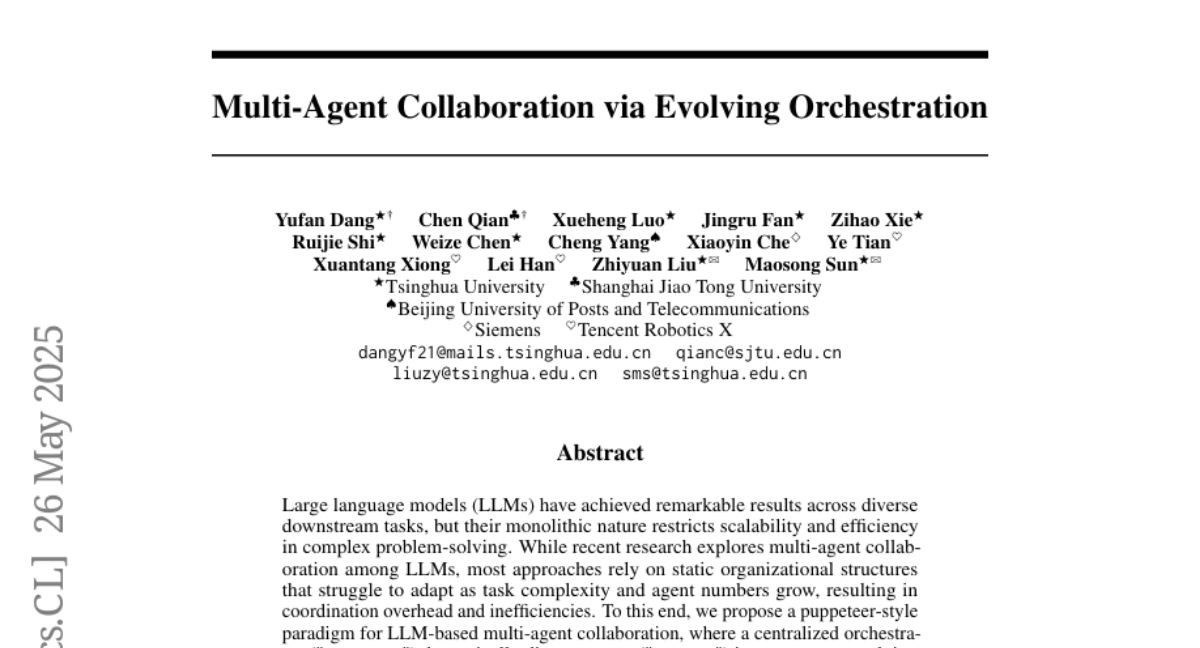
Multi-Agent Collaboration via Evolving Orchestration

A centralized orchestrator dynamically directs LLM agents via reinforcement learning, achieving superior multi-agent collaboration in varying tasks with reduced computational costs.

  • 14 authors
· May 26, 2025
Submitted by
AdinaY

DeepPlanning: Benchmarking Long-Horizon Agentic Planning with Verifiable Constraints

DeepPlanning benchmark addresses limitations of current LLM planning assessments by introducing complex, real-world tasks requiring both global optimization and local constraint reasoning.

Qwen Qwen · Jan 26, 2026
Submitted by
xw27

ARLArena: A Unified Framework for Stable Agentic Reinforcement Learning

ARLArena framework analyzes training stability in agentic reinforcement learning and proposes SAMPO method for stable policy optimization across diverse tasks.

Zep: A Temporal Knowledge Graph Architecture for Agent Memory

Zep, a memory layer service, outperforms MemGPT in the DMR benchmark and LongMemEval by excelling in dynamic knowledge integration and temporal reasoning, critical for enterprise use cases.

  • 5 authors
· Jan 20, 2025

dots.ocr: Multilingual Document Layout Parsing in a Single Vision-Language Model

A unified Vision-Language Model, dots.ocr, achieves state-of-the-art performance on document layout parsing by jointly learning layout detection, text recognition, and relational understanding, validated on OmniDocBench and XDocParse benchmarks.

rednote-hilab rednote-hilab · Dec 2, 2025

PyTorch Distributed: Experiences on Accelerating Data Parallel Training

The PyTorch distributed data parallel module optimizes large-scale model training using techniques like gradient bucketing, computation-communication overlap, and selective synchronization to achieve near-linear scalability.

  • 11 authors
· Jun 28, 2020
Submitted by
unilm

VibeVoice Technical Report

VibeVoice synthesizes long-form multi-speaker speech using next-token diffusion and a highly efficient continuous speech tokenizer, achieving superior performance and fidelity.

MicrosoftResearch Microsoft Research · Aug 26, 2025
Submitted by
taesiri

FireRed-Image-Edit-1.0 Techinical Report

FireRed-Image-Edit uses a diffusion transformer with optimized data curation and training methods to achieve state-of-the-art performance in instruction-based image editing, supported by a comprehensive benchmark and novel techniques for data efficiency and optimization stability.

  • 19 authors
· Feb 12, 2026
Submitted by
taesiri

LTX-2: Efficient Joint Audio-Visual Foundation Model

LTX-2 is an open-source audiovisual diffusion model that generates synchronized video and audio content using a dual-stream transformer architecture with cross-modal attention and classifier-free guidance.

  • 29 authors
· Jan 6, 2026
Submitted by
taesiri

AgentScope 1.0: A Developer-Centric Framework for Building Agentic Applications

AgentScope enhances agentic applications by providing flexible tool-based interactions, unified interfaces, and advanced infrastructure based on the ReAct paradigm, supporting efficient and safe development and deployment.

  • 23 authors
· Aug 22, 2025
Submitted by
taesiri

World Action Models are Zero-shot Policies

DreamZero is a World Action Model that leverages video diffusion to enable better generalization of physical motions across novel environments and embodiments compared to vision-language-action models.

Submitted by
daixufang

Agent Lightning: Train ANY AI Agents with Reinforcement Learning

Agent Lightning is a flexible RL framework for training LLMs in various agents, using a hierarchical RL algorithm and decoupling execution from training to handle complex interactions.

  • 8 authors
· Aug 5, 2025
Submitted by
akhaliq

Very Large-Scale Multi-Agent Simulation in AgentScope

Enhancements to the AgentScope platform improve scalability, efficiency, and ease of use for large-scale multi-agent simulations through distributed mechanisms, flexible environments, and user-friendly tools.

  • 8 authors
· Jul 25, 2024
Submitted by
CSJianYang

Evaluating and Aligning CodeLLMs on Human Preference

A human-curated benchmark (CodeArena) and a large synthetic instruction corpus (SynCode-Instruct) are introduced to evaluate code LLMs based on human preference alignment, revealing performance differences between open-source and proprietary models.

  • 10 authors
· Dec 6, 2024
Submitted by
zhongwenxu

Single-stream Policy Optimization

Single-stream Policy Optimization (SPO) improves policy-gradient training for Large Language Models by eliminating group-based issues and providing a stable, low-variance learning signal, leading to better performance and efficiency.

tencent Tencent · Sep 16, 2025
Submitted by
LakshyAAAgrawal

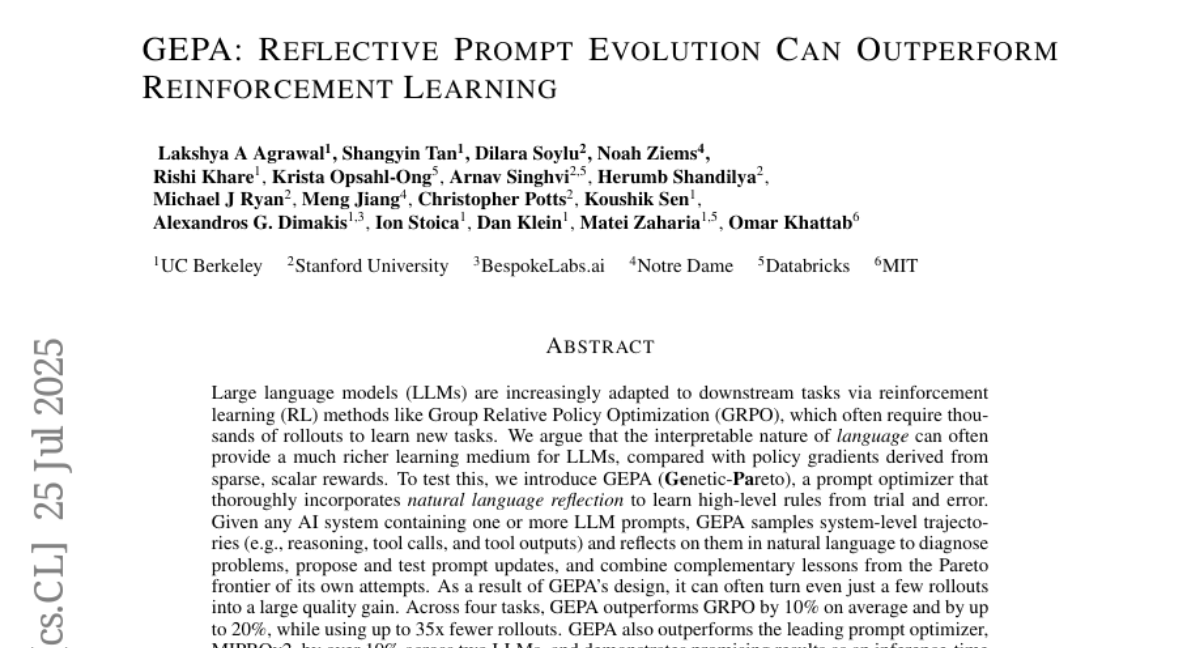
GEPA: Reflective Prompt Evolution Can Outperform Reinforcement Learning

GEPA, a prompt optimizer using natural language reflection, outperforms RL methods like GRPO and MIPROv2 with fewer rollouts by learning high-level rules from trial and error.

  • 17 authors
· Jul 25, 2025

DeepSeek-V3 Technical Report

DeepSeek-V3 is a parameter-efficient Mixture-of-Experts language model using MLA and DeepSeekMoE architectures, achieving high performance with efficient training and minimal computational cost.

deepseek-ai DeepSeek · Dec 27, 2024
Submitted by
rajkumarrawal

Recursive Language Models

We study allowing large language models (LLMs) to process arbitrarily long prompts through the lens of inference-time scaling. We propose Recursive Language Models (RLMs), a general inference strategy that treats long prompts as part of an external environment and allows the LLM to programmatically examine, decompose, and recursively call itself over snippets of the prompt. We find that RLMs successfully handle inputs up to two orders of magnitude beyond model context windows and, even for shorter prompts, dramatically outperform the quality of base LLMs and common long-context scaffolds across four diverse long-context tasks, while having comparable (or cheaper) cost per query.